Halpin
The origin of the name "Halpin" gives a clear picture of someone in the distant past -- that is, the progenitor of the family name.
In the distant past, people did not have last names. Jewish people were known by their given Hebrew or Jewish name and the given name of their father (or sometimes their mother). Last names for all people were first encountered in the middle ages and that for Jewish people in the 1700s. Last names were taken from where one lived, what one's occupation was, their station in life, and anything else that was important to the family. In the case of Jewish people, names were also assigned in countries like Germany and sometimes the assignment was an anti-semetic and/or demeaning word.
Common examples of last names that continue today and their original meaning are: Johnson (the son of "John"), "Smith" (a blacksmith), and "Rivers" (someone who lived near a river).
Examples of familiar Jewish names include: "Cohen" (a "Cohain" or member of the priestly caste in Judaism, "Levy" (a "Levite" or member of the Levite caste who ministered to the Cohanim), Israel (a person of the commoner caste of "Israelites"), "Berg" (a person who lived near or on a mountain -- "Berg" means mountain in German), and "Schane" (from the German "schoen," which means "pretty").
The Rothschild family is renoun and are among the leading financiers in the world. Their last name comes about from the fact that, in the 1700s, they, along with many Jews, lived in a ghetto (a segregated community that had a wall or fence around it and the occupants were not permitted out of the ghetto to mingle with the other member of the community except during specific hours, usually day hours, and to do specific work). Because it was necessary to identify people in the ghetto, it was common practice to put some kind of sign or symbol on the outside of a family's house. The family that hung a red shield on the outside of their home became known as "Rothschild," which in German means "red shield."
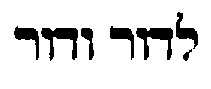
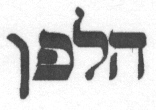
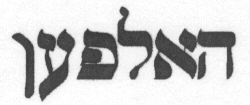
In Hebrew, Halpin is "Chalphen" and means "a money changer." There are some documents in which the name is spelled "Halppen" and "Halppin."
Chalphen in Hebrew is In Yiddish it is
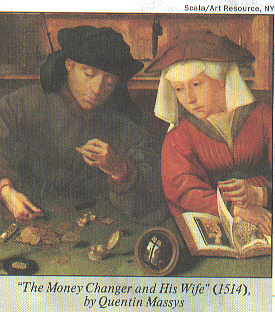
And so, the first Halpin (Chalphen or Chalphin) very likely, if not certainly, engaged in changing money as his occupation. He would have made transactions of converting the currency of one country or region to that of another country or region. For this work, he surely received a commission, which was the source of income for his family. In the past, it was not uncommon for regions in a country to have different currency from other regions, as well as there being different currency from country to country. The occupation was immortalized in the painting belwo done in 1514 by Quentin Massays.