Frequently, when immigrants to North America from Europe spoke about where they were from, they did not always speak precisely about their home town or village, but instead would reference a larger, more well-known area or city.
So it was with the Halpin family whose origins were in a small village in Romania, which which they called "Sculine," but which is actually "Siculeni." Mention was also made of coming from Bessarabia (an area) and Odessa (a city) that were larger and more well recognized than Siculeni.
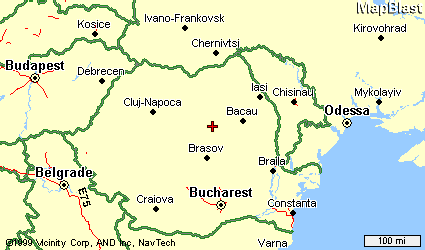
Siculeni is located at Latitude 46.239 N, Longitude 25.7556 E in the country of Romania. The history of Bessarabia (now the Republic of Moldova) and that of Odessa follow after the map below.
BESSARABIA (pronounced: besurAbEu) is a historic region of southeastern Europe, east of Romania, corresponding to the present-day republic of Moldova, except for its northern and southern sections, which are in the Ukraine. The region probably derived its name from that of the Basarabs, a Romanian princely dynasty that ruled neighboring Wallachia from the 14th to the 17th century.
Bessarabia has a land area of 44,421 square kilometers (17,151 square miles) and is bordered on the south by the Danube delta and Black Sea, on the west by the Moldavan region of Romania and the Prut River, and on the north and east by the Dnestr River. Its population is comprised of Moldavians (about two-thirds of the population), Ukrainians, Russians, Jews, and Bulgarians.
As the gateway from Russia into the Danube valley, Bessarabia has been an invasion route from Asia to Europe. Greek colonies were planted on the Black Sea coast of Bessarabia as early as the 7th century B.C.E. The region was later part of Roman Dacia, but after the 4th century C.E. it was subject to incursions by Goths, Huns, Avars, and Magyars. Slavs first settled in Bessarabia in the 7th cent. in the midst of these incursions. From the 9th to the 11th cent., the area was part of Kievan Russia, and in the 12th century it belonged to the duchy of Galich-Volhynia. Cumans and later Mongols overran Bessarabia. After the Mongols withdrew, it was included (1367) in the newly established principality of Moldavia.
Control of the area continued to changed numerous time since the Middle Ages. In 1513, the Ottoman Turks and their vassals, the khans of the Crimean Tatars, conquered Bessarabia. After the Russo-Turkish wars, the region was given to the Russian Empire by the Treaty of Bucharest (1812). The Crimean War resulted (1856) in Russia's giving Southern Bessarabia to Moldavia, but the Congress of Berlin (1878) returned the district to Russia. When the kingdom of Romania was established in 1881, it laid claim to the region, which had a large Romanian-speaking population.
After the Bolshevik Revolution (1917) and the breakup of the Russian Empire, the anti-Soviet national council of Bessarabia proclaimed the region an autonomous republic; however, in 1918, Bessarabia renounced all ties with Soviet Russia and declared itself an independent Moldovan republic, later voting for union with Romania. Although the Treaty of Paris (1920) recognized the union, Russia never accepted it, and in 1940 Romania was forced to return Bessarabia to the Union of Soviet Socialist Republics (USSR).
During World War II, Bessarabia was occupied by Soviet troops in 1940, retaken by Romania the following year, and reoccupied by the Soviets in 1944. The Romanian peace treaty of 1947 made Bessarabia part of the Union of Soviet Socialist Republics (USSR). From 1947 to 1991, Bessarabia was part of the Union of Soviet Socialist Republics when the larger part of the region was merged with the already existing Moldavian ASSR (Autonomous Soviet Socialist Republic) across the Dnestr, to form the Moldavian SSR (Soviet Socialist Republic). The northernmost area and the coastal strip along the Black Sea, with a predominantly Ukrainian-speaking population, became part of the Soviet Ukraine. In 1991, the Moldavian SSR became the present-day republic of Moldova.
ODESSA (pronounced: Odes u, in Russian: udye su), a port city on Odessa Bay of the Black Sea with over a million residents, is the capital of Odessa region in the Ukraine. It is the third largest Ukrainian city after Kiev and Kharkov. Ukrainians, Russians, Jews, and Greeks predominate in Odessa's cosmopolitan population.
The city is said to occupy the site of an ancient Miletian Greek colony (Odessos, Ordyssos, or Ordas) that disappeared between the 3d and 4th centuries C.E. Over the centuries, the city changed hands as a result of wars in the area. It is now in the republic of the Ukraine, which was a part of the Union of Soviet Socialist Republics (USSR).
Odessa was a center for Greek and Bulgarian patriots who came to the area, of the Ukrainian cultural and national movement, of Jewish culture, and of the labor movement and social democracy. The city's first workers' organization was founded in 1875 and the city was the scene in 1905 of a workers' outbreak led by sailors from the Russian battleship Potemkin.
Despite a heroic defense during World War II, the city fell to German and Romanian forces in October 1941. It was under Romanian administration as the capital of Transnistra until its liberation (April 1944) by the Soviet Army. Many buildings were ruined, and approximately 280,000 civilians (mostly Jews) were reportedly killed or deported during the German and Romanian occupation.